



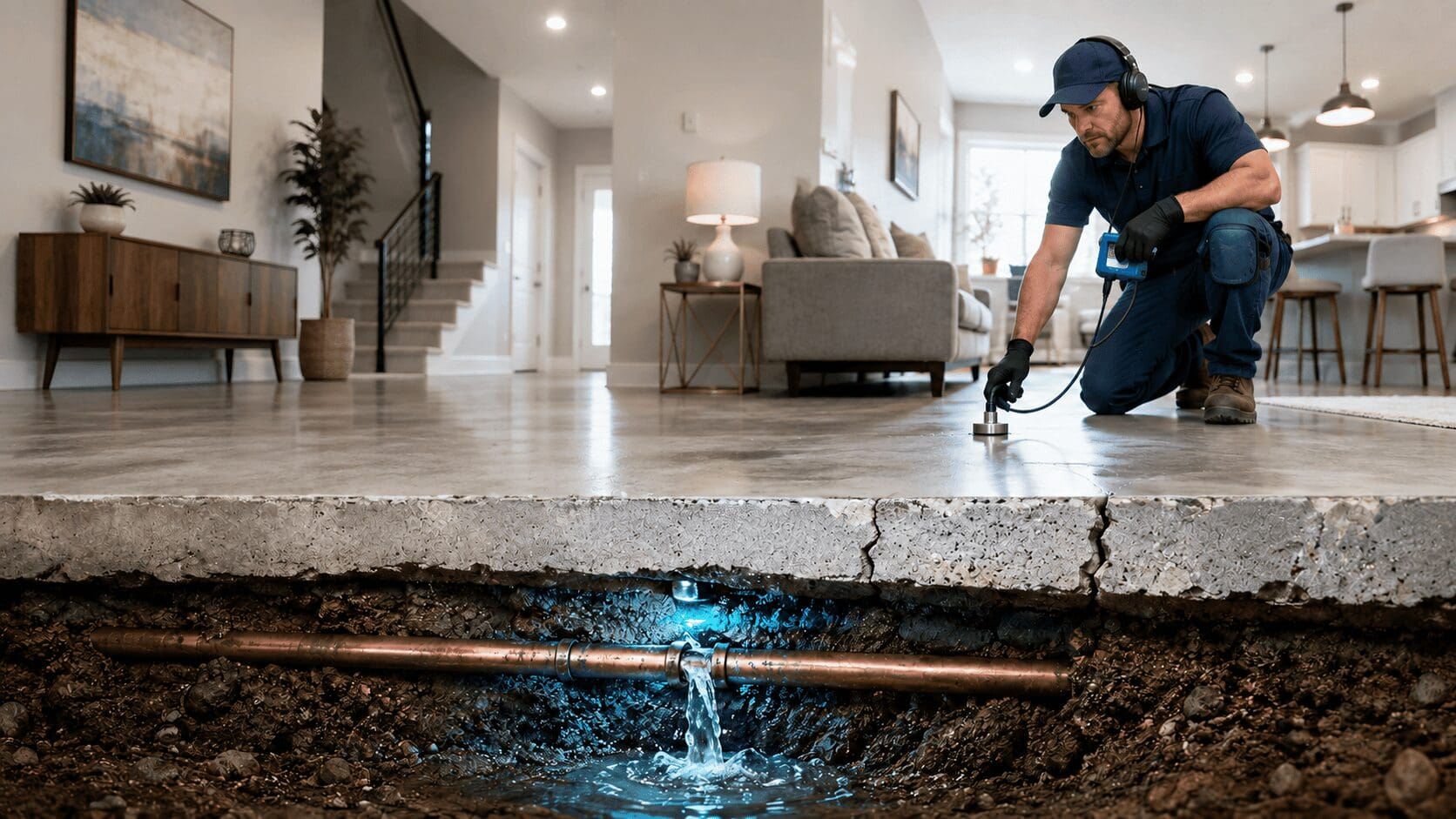
A slab leak is a break in a water line underneath the concrete foundation of your home. These are difficult to see and often silent until a visible sign manifests itself. By the time it is discovered, it has often already been happening for weeks.
The good news is that slab leak repair is typically a simple matter of patching up the hole and reinforcing the subfloor: The average cost is $2,280, and detection alone runs $150 to $400. What isn’t manageable is what happens when it goes unfound. Water damage repairs start near $500 to repair a small section of subfloor and climb over $15,000 once mold and structural damage are in play. If the leak washes out enough soil to shift the foundation, underpinning runs roughly $2,500 per pier.
That’s why this $280 leak detection call is worth knowing the warning signs.
What a Slab Leak Actually Is
Homes built on a slab foundation have supply lines running through or under the slab, which can develop leaks. These are caused by abrasion from the concrete, corrosion in the case of old copper lines, shifting of the ground, and water chemistry issues.
Leakage in the hot and cold supply lines behaves differently, which is useful knowledge when looking for a leak.
Age and location are factors in slab leaks, as slab-on-grade construction is common to the American West and South. This is especially true for Texas, Arizona, California, and Florida, where slab leaks are most common. The homes most at risk for slab leaks are those built before the mid-1990s with copper supply lines under the slab, as thin copper wall thicknesses and the combination of concrete and soil accelerate corrosion on both sides of the pipe.
If your home is built on a slab, is over twenty-five years old, and hasn’t been repiped, you should know these warning signs.
The 7 Warning Signs of a Slab Leak
1. Your water bill is mysteriously high
This is the most common warning sign, as an increase in water usage by a third or more can be an obvious sign that water is being lost somewhere. This spike in water usage has to go somewhere, and if it isn’t being used by your fixtures, it’s being swallowed up by a slab leak.
2. You can hear running water when all the faucets are off
Turn off all the water-using appliances and fixtures in the house and listen closely: if you hear dripping or running water, it’s a good idea to call a plumber to investigate.
3. One area on your floor is warm
A warm spot on the tile or wood, especially one that pets seem to gravitate toward, can be a sign of a hot water line leaking underneath the surface.
4. Your floor is damp, buckling, or discolored
Wet carpet, buckling hardwood, or uneven tile can be signs that water is coming up through the slab, rather than the other way around.
5. Your water pressure has suddenly dropped
One or two fixtures with low pressure is normal, but if the entire house is suddenly affected, it can be a sign that water pressure is being bled through a slab leak.
6. New cracks have appeared in your walls, floor, or foundation
Water leaking under a slab changes the moisture content of the soil, which can cause the slab to shift. This can cause cracks to appear in the drywall, tile, and foundation.
7. You can smell mildew and can’t find the source
Musty smelling air with no obvious source of dampness can be the result of mold growing somewhere out of sight, fed by a slab leak.

The Two-Minute Test You Can Perform Today
Turn off all the water-using appliances and fixtures in the house, including the ice maker. Go to the water meter and check the leak detection dial or, if you have an older meter, the small leak indicator. Wait fifteen minutes with no water being used, then check again: if the numbers have changed, you leak somewhere in your supply lines. This is not a definitive test for a slab leak, but it is a good preliminary step to confirm the suspicion and give a plumber a good idea of the situation when they arrive.
What Slab Leak Repair Costs
Leak detection typically costs between $280. The repair itself typically runs $630 to $4,400, with an average near $2,280 with access issues driving it up to $6,750.
The repair itself depends on the situation: a small pinhole in the supply line repaired from the subfloor costs between $150 to $800, while rerouting the entire supply line above the slab costs $600 to $4,000 and is often a better long-term investment on an older slab foundation.
Quick Answers
Does homeowners insurance cover a slab leak?
Most policies will cover the damage to the home caused by a slab leak, but not the repair to the water line itself, and coverage varies widely by state and provider. It’s best to check with your provider to find out what you’re covered for.
Can a slab leak repair itself?
No, a slab leak cannot repair itself. Water under pressure will always push its way out, and the only way to stop it is to call a plumber.
How do plumbers detect slab leaks?
Listening devices, thermal imaging, and pressure testing of individual lines: a professional plumber will use all the tools at their disposal to find the source of a slab leak before doing any destructive work like breaking up the slab.
Catch It While It’s Still a Plumbing Bill
A slab leak is a plumbing bill, but if ignored, it becomes a flooring bill, a mold remediation bill, and a foundation bill.
If two or more of these warning signs sound concerning, schedule a leak detection service before doing anything else. Call or book an inspection online.